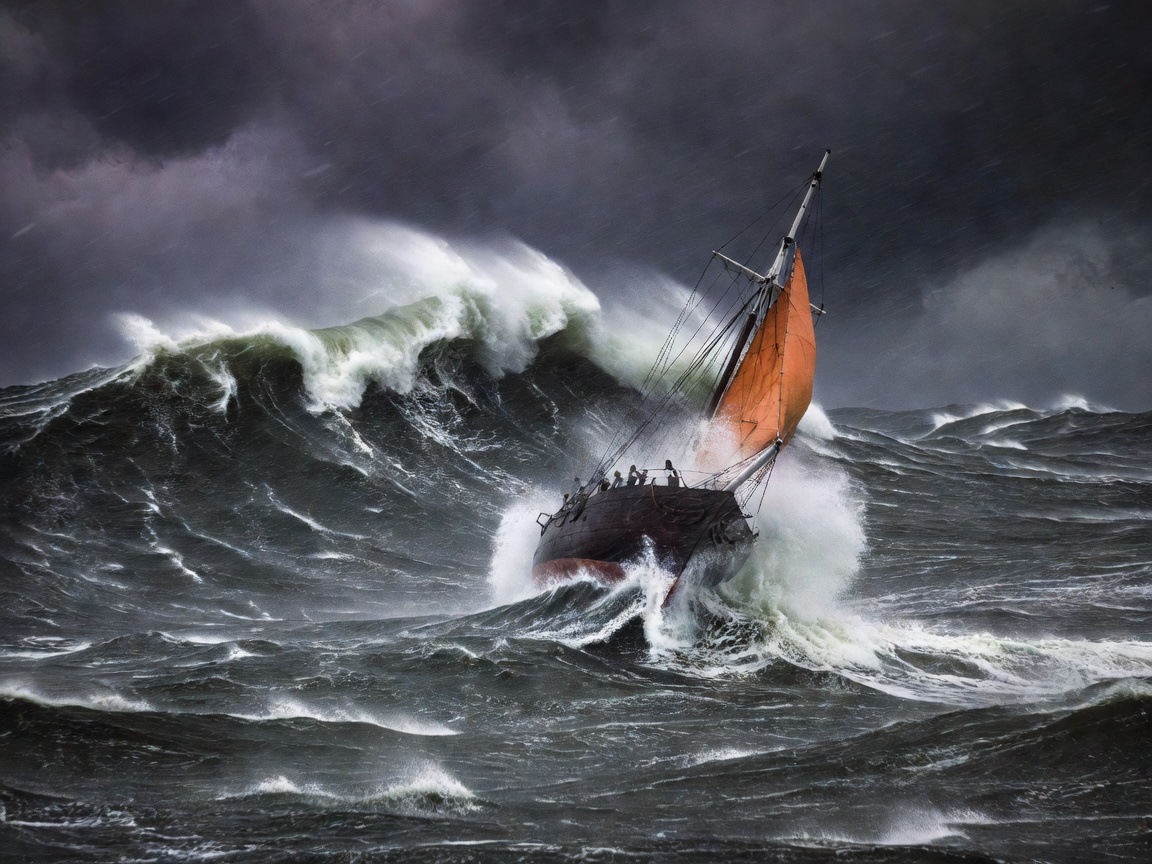
Introduction: The Physics of Heavy Weather Survival
When wind speeds exceed 35 knots and breaking seas reach heights greater than the yacht's beam, standard sailing tactics no longer apply. The paramount objective shifts from speed optimization to hydrodynamic stability, hull load reduction, and crew safety.
The fundamental risk in heavy weather is not wind velocity itself, but rather breaking wave energy hitting the topsides or stern. A breaking wave traveling at 25 knots delivers kinetic impact force exceeding 3 to 5 metric tons per square meter, easily capable of causing structural damage or knockdowns.
Strategy 1: The Heave-To Maneuver
Heaving-to is an essential seamanship maneuver where the vessel lies nearly stationary relative to the water, angled approximately 45° to 60° relative to incoming waves, creating a protective "slick" of turbulent water upwind that dampens incoming breaking wave crests.
Step-by-Step Heaving-To Sequence:
- Tack Without Easing the Jib Sheet: Execute a standard tack upwind, but leave the headsail cleated on the original windward side so that it becomes backed by the wind.
- Ease the Mainsail Sheet Completely: Allow the mainsail to spill power so the vessel loses forward momentum.
- Put the Helm Hard to Lee: Turn the wheel or tiller firmly toward the wind (as if trying to tack back) and lash it securely in place.
The backed jib attempts to turn the bow away from the wind, while the rudder attempts to turn the bow into the wind. These opposing hydrodynamic forces stabilize the boat at a gentle drift of 1 to 2 knots downwind.
Storm Canvas Selection Rules
• Storm Trysail: Must be rigged on an independent mast track with heavy-duty sheets led to primary winches.
• Storm Jib: Area must not exceed 5% of the height of the foretriangle squared ($0.05 \times I^2$).
Strategy 2: Running Before the Gale with Sea Anchors & Drogues
When sea room downwind is available, running off before the storm can be effective. However, as wave steepness increases, there is severe danger of pitchpoling (the bow diving into a trough while the stern is lifted over by a breaking wave behind) or broaching.
The Jordan Series Drogue (JSD)
The Jordan Series Drogue consists of 100 to 150 small fabric cones attached along a weighted line bridle deployed from the vessel's stern. Unlike a single large parachute sea anchor, a series drogue maintains constant, smooth tension as individual cones submerge and emerge from wave crests, keeping the yacht aligned stern-first to incoming seas while maintaining a steady velocity of 1.5 to 2.5 knots.
Summary Recommendations for Skippers
- Prepare heavy weather gear and storm tacking lines before leaving the harbor.
- Double-check bilge pumps, manual pump handles, and storm washboards.
- Maintain a continuous watch for structural fatigue on chainplates and forestay toggles.